
How Does an RFID Door Lock System Work?

In today’s fast-paced world, security and convenience are top priorities for homes, offices, and hotels. Traditional lock-and-key systems are gradually being replaced by advanced technologies, one of which is the RFID door lock system.
RFID (Radio Frequency Identification) door locks provide a keyless entry solution, enhancing security while offering ease of access. But how exactly do they work? This article explains the technology behind RFID door locks, their components, advantages, and potential drawbacks.
What Is an RFID Door Lock System?
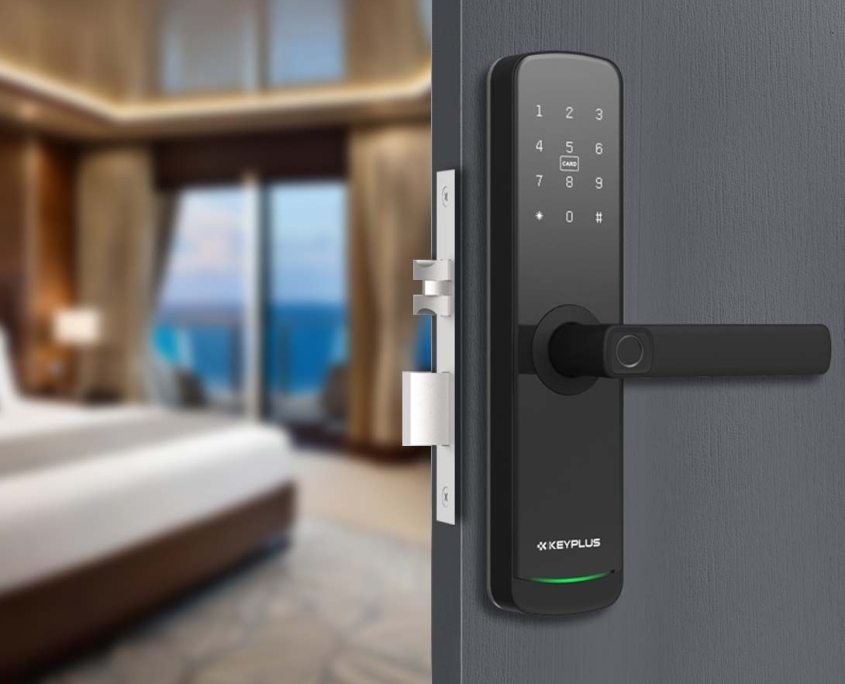
An RFID door lock is an electronic locking mechanism that uses radio waves to identify and authenticate users. Instead of a physical key, users carry an RFID card, key fob, or even a smartphone with an embedded RFID chip. When the RFID tag is brought near the reader, the system verifies the credentials and grants or denies access.
These systems are widely used in:
-
Hotels (replacing traditional key cards)
-
Office buildings (for employee access control)
-
Residential homes (smart locks)
-
Gated communities and parking lots
Key Components of an RFID Door Lock System
An RFID door lock system consists of several essential components:
1. RFID Tags (Keycards, Fobs, or Smartphone NFC)
-
These contain a microchip and an antenna that transmits data via radio waves.
-
Types:
-
Low-frequency (LF) RFID (125 kHz) – Common in older systems.
-
High-frequency (HF) RFID (13.56 MHz) – Used in modern systems (e.g., NFC-enabled smartphones).
-
Ultra-high-frequency (UHF) RFID (860-960 MHz) – Used for long-range detection (less common in door locks).
-
2. RFID Reader
-
Installed near the door, it emits a radio signal to detect and read RFID tags.
-
When a tag is within range, the reader captures its unique ID and sends it to the control module.
3. Control Module (Lock Mechanism & Database)
-
The “brain” of the system, it checks the tag’s ID against a pre-approved database.
-
If the ID matches, it sends a signal to unlock the door.
-
Some advanced systems connect to a centralized access control system for real-time monitoring.
4. Electric Strike or Magnetic Lock
-
Replaces the traditional mechanical lock.
-
When authorized, the control module triggers the electric strike to release the door.
5. Power Supply
-
Most RFID locks are battery-powered (AA or lithium batteries).
-
Some high-security systems use backup power (e.g., in case of power outages).
How Does an RFID Door Lock Work? Step-by-Step
-
User Presents RFID Tag
-
The user holds an RFID card, key fob, or smartphone near the reader (usually within 2-10 cm).
-
-
RFID Reader Activates the Tag
-
The reader emits a radio signal that powers the passive RFID tag (no battery needed).
-
The tag sends back its unique identification number.
-
-
Authentication Process
-
The control module checks the tag’s ID against a stored database.
-
If the ID is authorized, the system triggers the lock to open.
-
-
Access Granted or Denied
-
If approved, the electric strike or magnetic lock disengages, allowing entry.
-
If denied, the door remains locked, and some systems log the unauthorized attempt.
-
-
Optional Logging & Remote Control
-
Many modern RFID locks record entry/exit times for security audits.
-
Some can be integrated with Wi-Fi or Bluetooth for remote access via a smartphone app.
-
Advantages of RFID Door Locks
Enhanced Security
-
No physical keys that can be lost or duplicated easily.
-
Each RFID tag has a unique ID, making unauthorized access difficult.
-
Lost cards can be deactivated instantly.
Convenience
-
No need to carry keys—just a card, fob, or smartphone.
-
Quick access without fumbling for keys.
Access Control & Monitoring
-
Admins can grant or revoke access remotely.
-
Entry logs help track who enters and exits.
Scalability
-
Easy to add or remove users without changing locks.
-
Suitable for large facilities with multiple entry points.
Potential Drawbacks
Risk of Cloning or Hacking
-
Some low-frequency RFID tags can be cloned using cheap devices.
-
High-frequency (NFC) systems are more secure but not immune to hacking.
Dependence on Power
-
Battery-operated locks need periodic replacement.
-
Power outages could affect functionality (unless backup exists).
Initial Cost
-
More expensive than traditional locks but cost-effective in the long run.
RFID vs. Other Smart Lock Technologies
| Feature | RFID Lock | Keypad Lock | Bluetooth/Wi-Fi Lock |
|---|---|---|---|
| Authentication | RFID Card/Fob | PIN Code | Smartphone |
| Security | Medium-High | Medium (if PIN is weak) | High (encrypted) |
| Convenience | High (tap-to-open) | Medium (remember PIN) | High (auto-unlock) |
| Power Needs | Battery | Battery | Battery/Wi-Fi |
Conclusion
RFID door lock systems provide a secure, convenient, and scalable alternative to traditional keys. By using radio waves for authentication, they eliminate the need for physical keys while allowing detailed access control.
While they are not entirely foolproof (no system is), advancements in encryption and NFC technology continue to improve their security. For homes, offices, and hotels looking to upgrade their security, RFID locks offer a reliable and modern solution.
Would you consider switching to an RFID door lock? Let us know in the comments!
Related Blog
 https://www.keyplusystem.com/wp-content/uploads/2026/10/image-20261010-080119085.png
1024
1536
Wu, Wendy
/wp-content/uploads/2023/05/logo.png
Wu, Wendy2026-10-10 06:01:302026-10-10 06:01:31Driving Hotel Efficiency with Advanced Digital Door Locks: The Ultimate B2B Guide
https://www.keyplusystem.com/wp-content/uploads/2026/10/image-20261010-080119085.png
1024
1536
Wu, Wendy
/wp-content/uploads/2023/05/logo.png
Wu, Wendy2026-10-10 06:01:302026-10-10 06:01:31Driving Hotel Efficiency with Advanced Digital Door Locks: The Ultimate B2B Guide https://www.keyplusystem.com/wp-content/uploads/2026/10/image-20261010-000134148.png
1024
1536
Wu, Wendy
/wp-content/uploads/2023/05/logo.png
Wu, Wendy2026-10-09 22:01:442026-10-09 22:01:46Revolutionizing Hotel Security: RFID Key Cards and AIoT Smart Lock Solutions by KEYPLUS
https://www.keyplusystem.com/wp-content/uploads/2026/10/image-20261010-000134148.png
1024
1536
Wu, Wendy
/wp-content/uploads/2023/05/logo.png
Wu, Wendy2026-10-09 22:01:442026-10-09 22:01:46Revolutionizing Hotel Security: RFID Key Cards and AIoT Smart Lock Solutions by KEYPLUS https://www.keyplusystem.com/wp-content/uploads/2026/10/image-20261009-160126393.png
1024
1536
Wu, Wendy
/wp-content/uploads/2023/05/logo.png
Wu, Wendy2026-10-09 14:01:362026-10-09 14:01:38The Future of Hospitality: Wireless Hotel Lock Systems Powered by KEYPLUS
https://www.keyplusystem.com/wp-content/uploads/2026/10/image-20261009-160126393.png
1024
1536
Wu, Wendy
/wp-content/uploads/2023/05/logo.png
Wu, Wendy2026-10-09 14:01:362026-10-09 14:01:38The Future of Hospitality: Wireless Hotel Lock Systems Powered by KEYPLUS https://www.keyplusystem.com/wp-content/uploads/2026/10/image-20261009-080202455.png
1024
1536
Wu, Wendy
/wp-content/uploads/2023/05/logo.png
Wu, Wendy2026-10-09 06:02:152026-10-09 06:02:17Revolutionizing Hotel Security: The Future of Smart Locks for Hospitality Spaces
https://www.keyplusystem.com/wp-content/uploads/2026/10/image-20261009-080202455.png
1024
1536
Wu, Wendy
/wp-content/uploads/2023/05/logo.png
Wu, Wendy2026-10-09 06:02:152026-10-09 06:02:17Revolutionizing Hotel Security: The Future of Smart Locks for Hospitality Spaces https://www.keyplusystem.com/wp-content/uploads/2026/10/image-20261009-000116876.png
1024
1536
Wu, Wendy
/wp-content/uploads/2023/05/logo.png
Wu, Wendy2026-10-08 22:01:272026-10-08 22:01:29Revolutionizing Hotel Room Security: How Smart Locks Enhance Guest Safety and Operational Efficiency
https://www.keyplusystem.com/wp-content/uploads/2026/10/image-20261009-000116876.png
1024
1536
Wu, Wendy
/wp-content/uploads/2023/05/logo.png
Wu, Wendy2026-10-08 22:01:272026-10-08 22:01:29Revolutionizing Hotel Room Security: How Smart Locks Enhance Guest Safety and Operational Efficiency https://www.keyplusystem.com/wp-content/uploads/2026/10/image-20261008-080144553.png
1024
1536
Wu, Wendy
/wp-content/uploads/2023/05/logo.png
Wu, Wendy2026-10-08 06:01:552026-10-08 06:01:57Why Portable Locks are a Game-Changer for Modern Hotel Room Security
https://www.keyplusystem.com/wp-content/uploads/2026/10/image-20261008-080144553.png
1024
1536
Wu, Wendy
/wp-content/uploads/2023/05/logo.png
Wu, Wendy2026-10-08 06:01:552026-10-08 06:01:57Why Portable Locks are a Game-Changer for Modern Hotel Room Security
